please note - this is a downloadable PDF crochet & knitting pattern, and not a finished item of clothing
*please note this pattern includes both knit and crochet elements
This stash-busting, oversized crochet zipper jacket is constructed top down, starting with the back yoke and working a portion of short rows before crocheting flat in full rows until the underarm depth is reached (this section is supported by photo examples). Stitches are then picked up along either shoulder and crocheted forwards, while working the same short rows as the back and also shaping the front neckline. Once stitches have been chained to add length to the front neckline the fronts are separately worked down to the underarm depth.
The body is then joined by chaining/adding more stitches under the arms and the rest is crocheted flat to the bottom rib. The body rib is then knitted, as well as the collar. Knit stitches are picked up along both sides of the front opening to make the zipper bands.
The sleeves are crocheted in the round starting from the armholes and shaped with decreases for a tapered look. The cuffs are also knitted.
After blocking, the zipper is sewn in and then strips of knit are sewn to conceal the zip on the inside of the jacket.
The whole piece is worked in crochet linen / moss stitch except from the knit rib.
Equipment:
Recommended hook size: 4mm (please gauge swatch to meet the correct measurements, my testers used between a 3.5mm - 5mm hook)
18 inch zip - it is important that if you change the body length you buy a different zipper length to accommodate this
Recommended needle size (for knit ribbing): 4mm (recommended to use circular needles for the cuffs)
Yarn needle (for weaving ends and seaming)
Stitch markers (optional but advised for short rows)
Scissors / embroidery scissors
Blocking mats (optional but advised)
Needle and thread (to sew in zip)
Pins (to hold zipper in place)
Gauge:
20 stitches x 20 rows for 4 x 4 inches / 10 x 10 cm in stitch pattern (this consists of 10 single crochets and 10 chains)
It is recommended to make a swatch bigger than 4”x4” inches - in the testing process it was discovered that this stitch behaves quite differently from a small to large scale. I would recommend an 8”x8” or 10”x10” swatch for a more accurate reading. In addition, measuring and trying on as you go is a crucial part of any project!
There are a few things to consider with this gauge - 20 stitches is actually referring to the amount of stitch spaces total, since the stitch consists of Ch1, Sc1 repeated, it is not the amount of single crochets. This is also referring to the final gauge after wet blocking.
Sizes:
There is an intended 11 inches of positive ease, and finished garment measurements are for after blocking. For busts smaller than 30 inches there will be more positive ease. For busts larger than 66 inches there will be less positive ease (please see schematic info)
(A, B, C, D) (E, F, G) (H, I, J)
bust circumference (41, 45, 49, 53) (57, 61, 65) (69, 73, 77)
Yarn estimations:
This pattern is designed to use up a selection of DK, worsted and aran weight scraps, but is predominantly a worsted weight. The sample garment is predominantly Hobbii Friends Wool with a few other random yarns used alongside those. You can use as many colours as you like, these will give you the total overall estimations. You can double up on fingering or use a combination of sizes to meet gauge.
My pattern testers were able to achieve gauge with a variety of these yarn thicknesses, some used between a 3.5mm and 5 mm crochet hook. Please swatch!
(A, B, C, D) (E, F, G) (H, I, J)
Total grams of DK/Worsted/Aran weight for the crochet (550g, 600g, 650g, 700g) (725g, 775g, 825g) (875g, 925g, 950g)
Total grams of DK/Worsted/Aran weight for the knit ribbing and edges (150g, 150g, 175g, 175g) (175g, 200g, 200g) (200g, 200g, 200g)
*please consider the fibre you use will influence yarn estimations, these are based on the Hobbii Friends Wool but may differ if using a combination of yarns
please note - this is a downloadable PDF crochet & knitting pattern, and not a finished item of clothing
*please note this pattern includes both knit and crochet elements
This stash-busting, oversized crochet zipper jacket is constructed top down, starting with the back yoke and working a portion of short rows before crocheting flat in full rows until the underarm depth is reached (this section is supported by photo examples). Stitches are then picked up along either shoulder and crocheted forwards, while working the same short rows as the back and also shaping the front neckline. Once stitches have been chained to add length to the front neckline the fronts are separately worked down to the underarm depth.
The body is then joined by chaining/adding more stitches under the arms and the rest is crocheted flat to the bottom rib. The body rib is then knitted, as well as the collar. Knit stitches are picked up along both sides of the front opening to make the zipper bands.
The sleeves are crocheted in the round starting from the armholes and shaped with decreases for a tapered look. The cuffs are also knitted.
After blocking, the zipper is sewn in and then strips of knit are sewn to conceal the zip on the inside of the jacket.
The whole piece is worked in crochet linen / moss stitch except from the knit rib.
Equipment:
Recommended hook size: 4mm (please gauge swatch to meet the correct measurements, my testers used between a 3.5mm - 5mm hook)
18 inch zip - it is important that if you change the body length you buy a different zipper length to accommodate this
Recommended needle size (for knit ribbing): 4mm (recommended to use circular needles for the cuffs)
Yarn needle (for weaving ends and seaming)
Stitch markers (optional but advised for short rows)
Scissors / embroidery scissors
Blocking mats (optional but advised)
Needle and thread (to sew in zip)
Pins (to hold zipper in place)
Gauge:
20 stitches x 20 rows for 4 x 4 inches / 10 x 10 cm in stitch pattern (this consists of 10 single crochets and 10 chains)
It is recommended to make a swatch bigger than 4”x4” inches - in the testing process it was discovered that this stitch behaves quite differently from a small to large scale. I would recommend an 8”x8” or 10”x10” swatch for a more accurate reading. In addition, measuring and trying on as you go is a crucial part of any project!
There are a few things to consider with this gauge - 20 stitches is actually referring to the amount of stitch spaces total, since the stitch consists of Ch1, Sc1 repeated, it is not the amount of single crochets. This is also referring to the final gauge after wet blocking.
Sizes:
There is an intended 11 inches of positive ease, and finished garment measurements are for after blocking. For busts smaller than 30 inches there will be more positive ease. For busts larger than 66 inches there will be less positive ease (please see schematic info)
(A, B, C, D) (E, F, G) (H, I, J)
bust circumference (41, 45, 49, 53) (57, 61, 65) (69, 73, 77)
Yarn estimations:
This pattern is designed to use up a selection of DK, worsted and aran weight scraps, but is predominantly a worsted weight. The sample garment is predominantly Hobbii Friends Wool with a few other random yarns used alongside those. You can use as many colours as you like, these will give you the total overall estimations. You can double up on fingering or use a combination of sizes to meet gauge.
My pattern testers were able to achieve gauge with a variety of these yarn thicknesses, some used between a 3.5mm and 5 mm crochet hook. Please swatch!
(A, B, C, D) (E, F, G) (H, I, J)
Total grams of DK/Worsted/Aran weight for the crochet (550g, 600g, 650g, 700g) (725g, 775g, 825g) (875g, 925g, 950g)
Total grams of DK/Worsted/Aran weight for the knit ribbing and edges (150g, 150g, 175g, 175g) (175g, 200g, 200g) (200g, 200g, 200g)
*please consider the fibre you use will influence yarn estimations, these are based on the Hobbii Friends Wool but may differ if using a combination of yarns
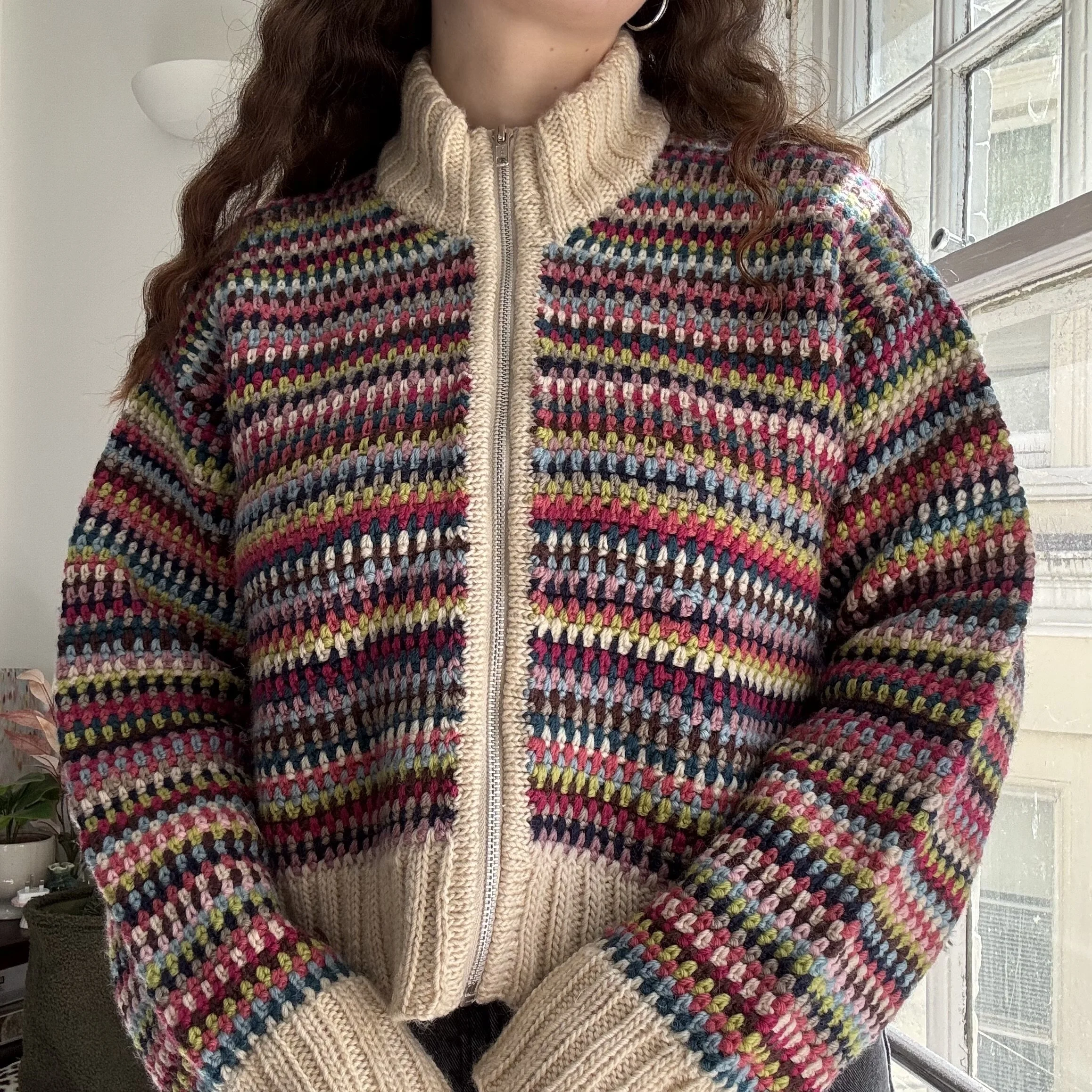 Image 1 of 7
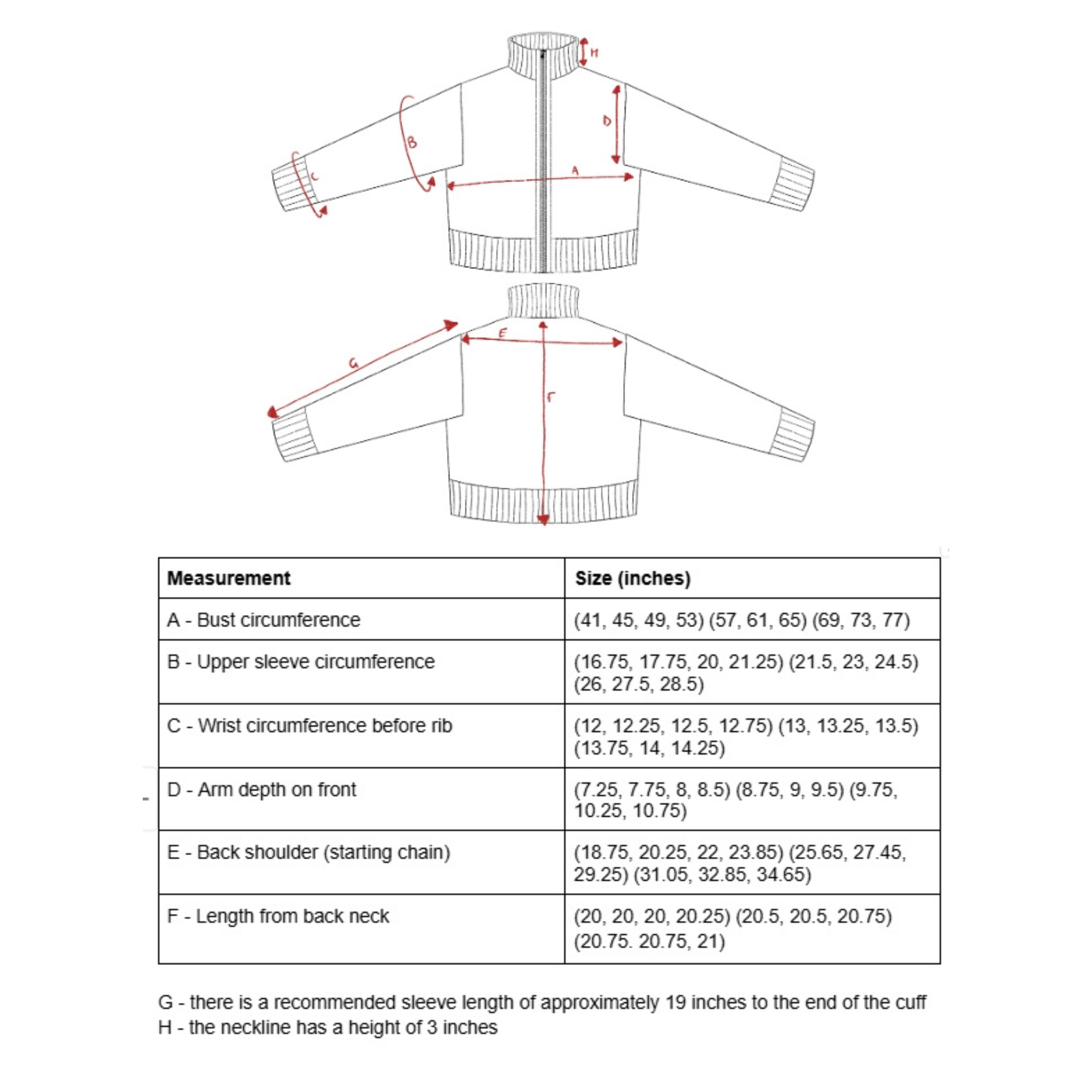 Image 2 of 7
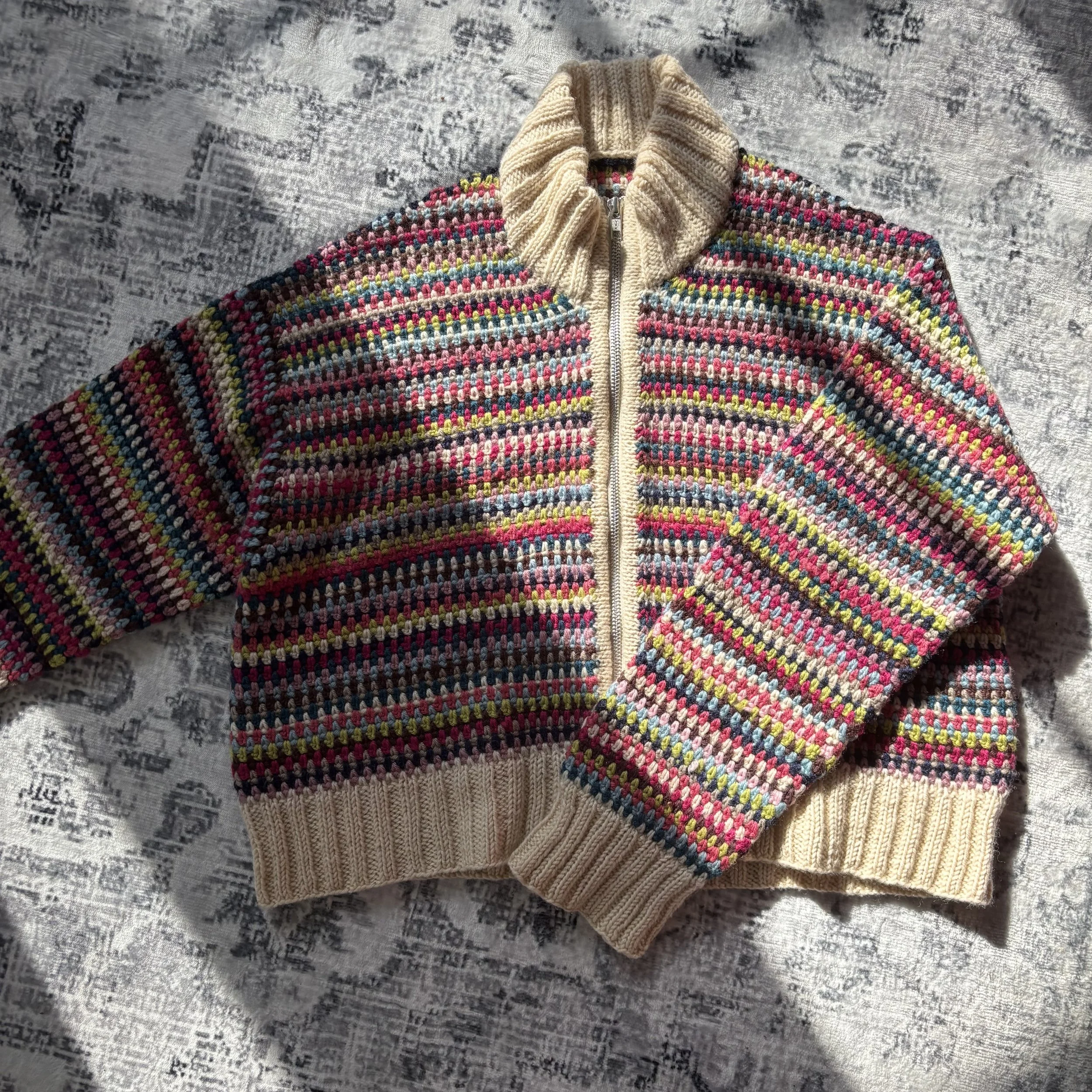 Image 3 of 7
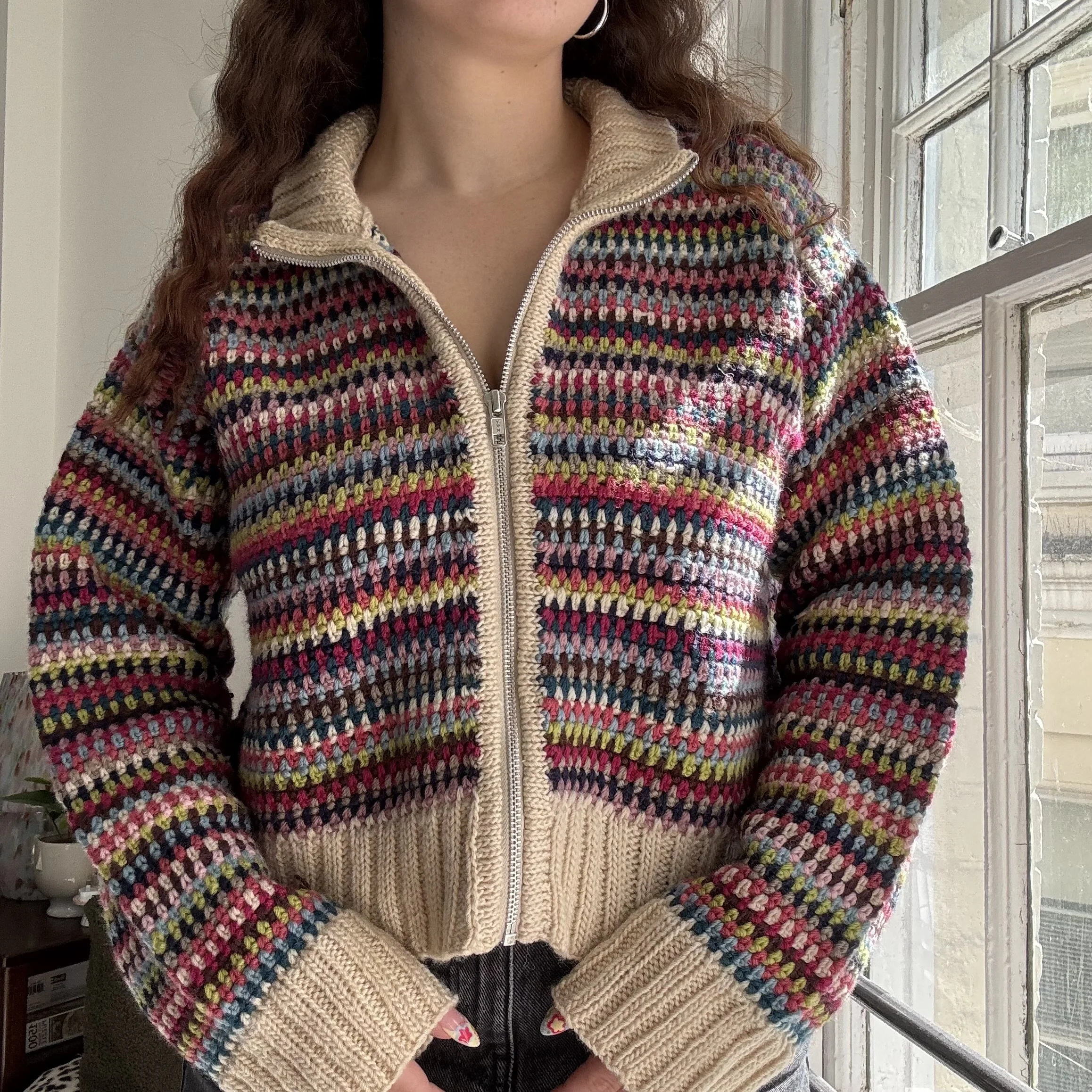 Image 4 of 7
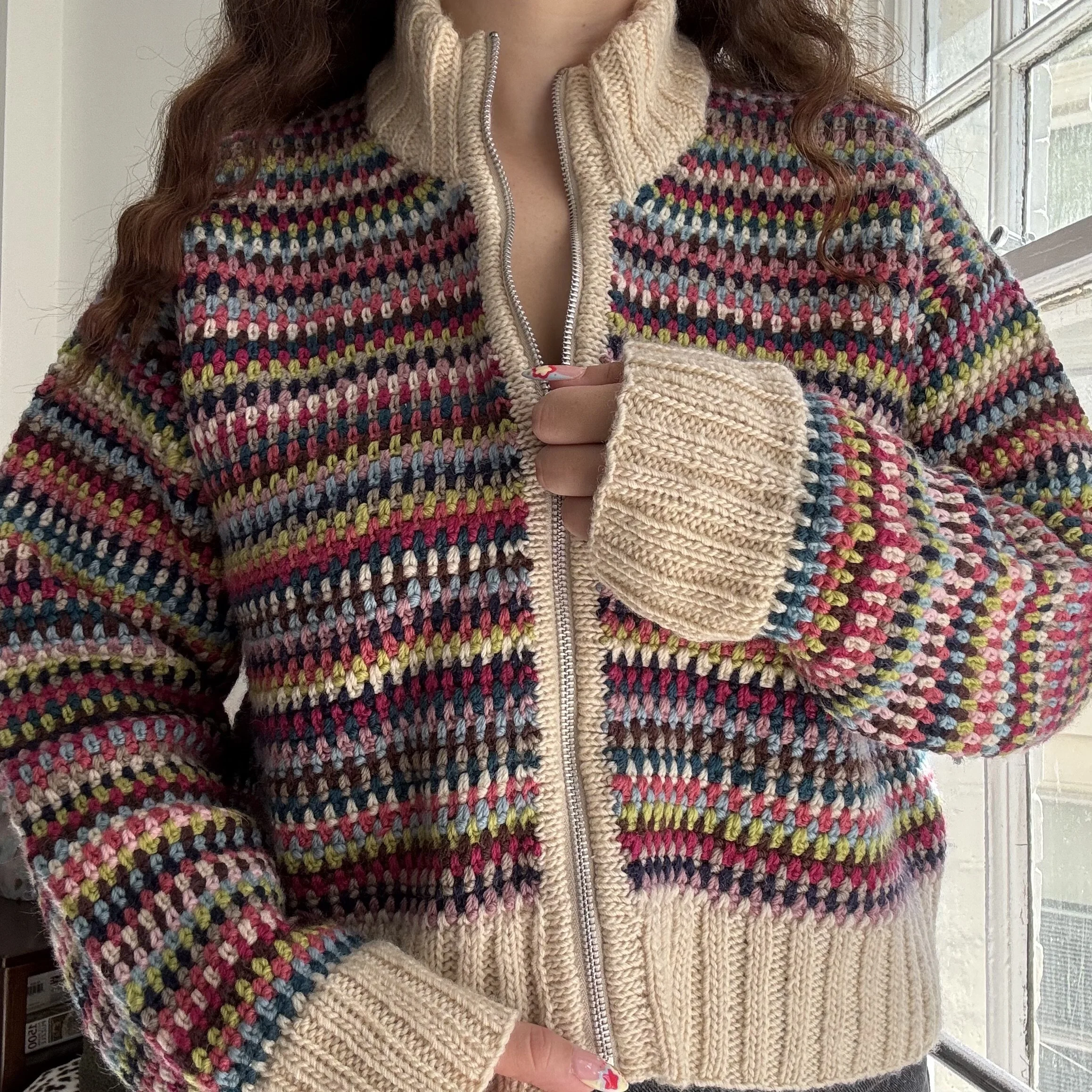 Image 5 of 7
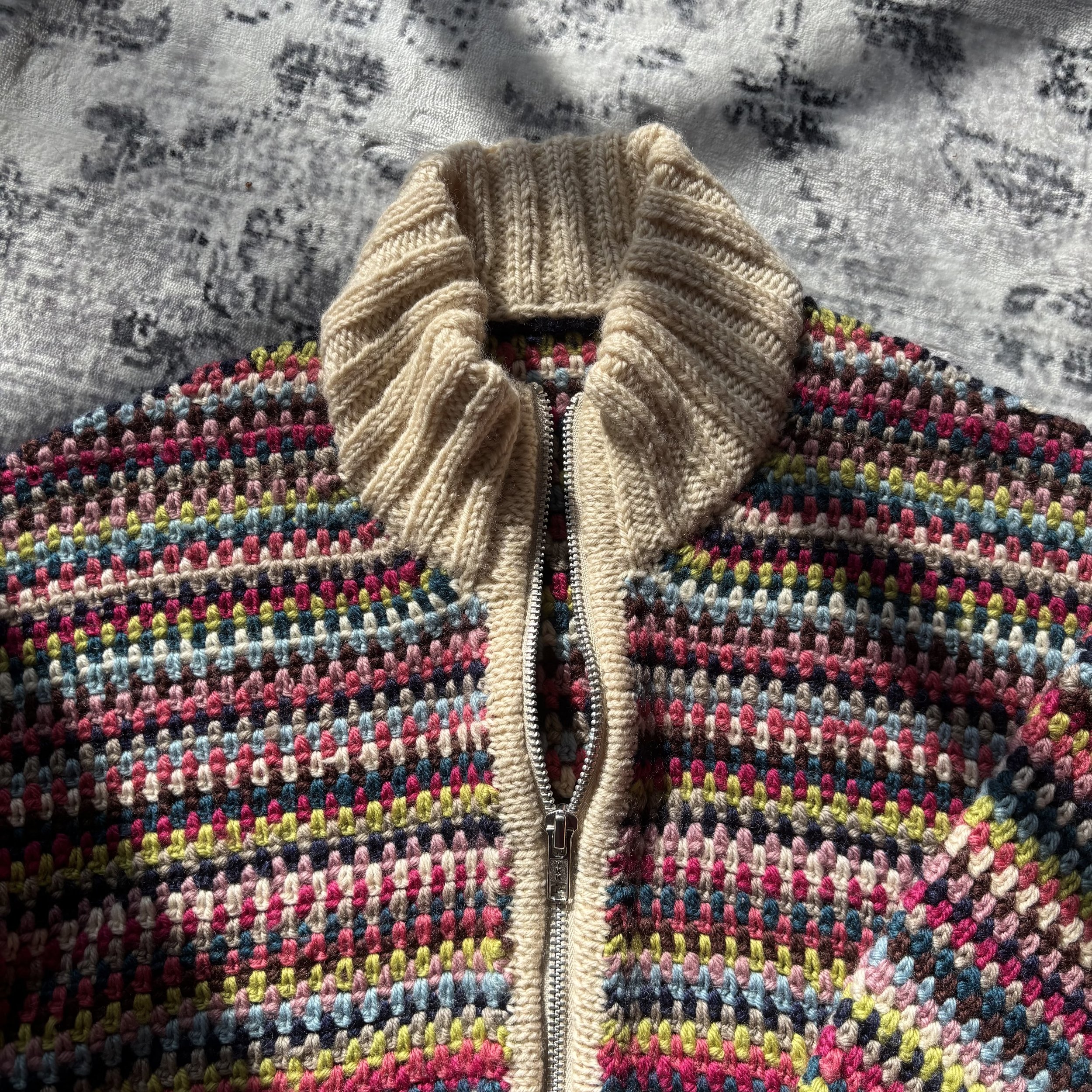 Image 6 of 7
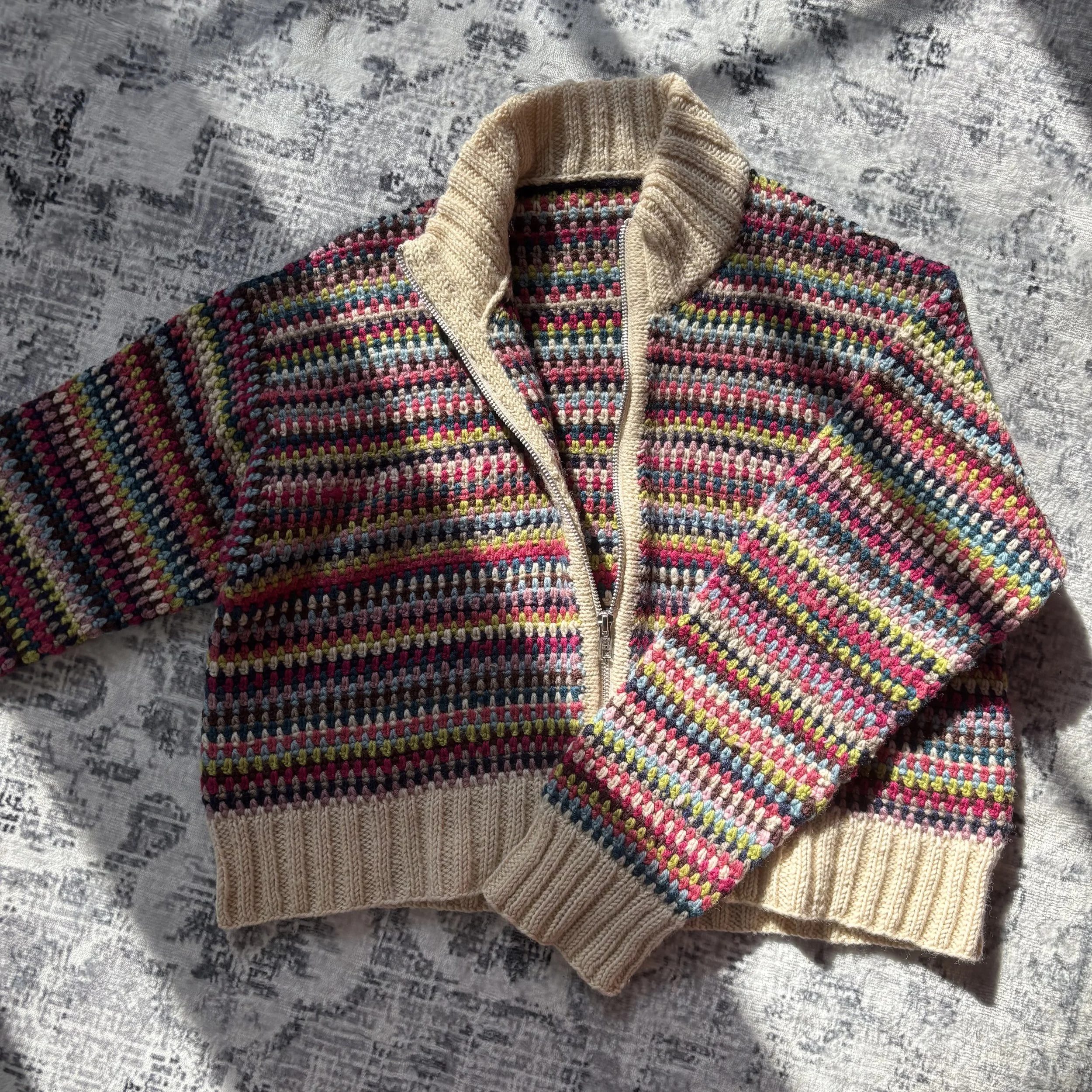 Image 7 of 7